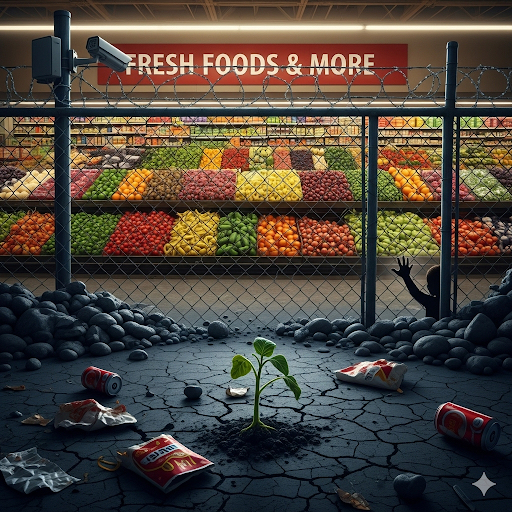
When we talk about food injustice, the term food desert often comes up. But the truth is deeper than that. What many communities face is food apartheid, a system of segregation that determines who has access to nutritious food and who doesn’t, based on race, class, and geography. Unlike the term desert, which implies something natural, apartheid reflects the systemic and intentional nature of these inequities.
In urban neighborhoods across the United States, fresh fruits, vegetables, and whole foods are scarce, while fast food chains and corner stores filled with processed options are abundant. Families are forced to make impossible choices: buy what’s cheap and accessible, or go without. The result? Higher rates of diabetes, heart disease, obesity, and mental health struggles in communities that deserve better.
This isn’t just a public health issue, it’s a social justice issue. When people are stripped of their ability to access nourishing food, they’re also stripped of dignity, vitality, and opportunity.
The Impact of Food Apartheid
- Health Disparities: Diet-related illnesses disproportionately impact Black, Brown, and low-income communities.
- Economic Strain: Families spend more money traveling far distances for fresh foods or are left dependent on costly, nutrient-poor convenience foods.
- Community Erosion: Lack of access to healthy food undermines community strength, resilience, and longevity.
How We Can Create Change
Change doesn’t just happen from the top down, it happens when we all choose to advocate and act. Here’s how we can dismantle food apartheid together:
Support Local Urban Gardens & Farmers Markets
Encourage and fund community-driven projects that grow and distribute fresh produce where it’s needed most.
Advocate for Policy Change
Push for zoning laws that prioritize grocery stores and co-ops over fast food chains in underserved areas.
Educate & Empower
Offer cooking classes, nutrition workshops, and wellness programs to show how accessible, affordable, plant-based eating can be achieved.
Invest in Food Justice Organizations
Support groups actively fighting food apartheid by redistributing resources and ensuring long-term solutions.
Build Community
Host food swaps, communal meals, and neighborhood wellness circles to restore relationships around food and health.
A Collective Responsibility
Food is a human right, not a luxury. To break the cycle of food apartheid, we must come together as individuals, communities, and systems to create an environment where everyone can thrive. Imagine a world where fresh food is abundant on every corner, where children grow up seeing gardens instead of liquor stores, and where communities reclaim their power through nourishment.
At Truly Wholistic Health and Wellness, we believe that healing starts on the plate but extends into every part of life. By fighting food apartheid, we’re not just feeding bodies, we’re fueling futures.
References
Bruening, M., Dinour, L. M., & Rosales Chavez, J. B. (2017). Food Insecurity and Emotional Health in the USA: A Systematic Narrative Review of Longitudinal Research. Public Health Nutrition, 1-9. https://doi.org/10.1017/S136898001700222
McLaughlin, K. A., Green, J. G., Alegra, M., Costello, E. J., Gruber, M. J., Sampson, N. A., & Kessler, R. C. (2012). Food Insecurity and Mental Disorders in a National Sample of U.S. Adolescents. Journal of the American Academy of Child & Adolescent Psychiatry 51(12), 1-11. https://doi.org/10.1016
Cardel, M. I., Tong, S., Pavela, G., Dhurandhar, E., Boles, R., & Haemer, M. (2018). Youth Subjective Social Status (SSS) is Associated with Parent SSS, In
 Truly Wholistic Health and Wellness