When I think about our children, their laughter, their potential, their boundless energy, I also think about the struggles I see in our communities every day. Children in urban schools are often labeled as “distracted,” “disruptive,” or “unfocused,” but what if part of the problem isn’t just behavior? What if it’s the food they eat, or the food they don’t have access to?
As the founder of Truly Wholistic Health and Wellness, I believe we can’t talk about wellness without talking about food, and we can’t talk about food without acknowledging equity. Too often, our children are living in areas where fresh, nourishing foods are scarce, but fast food and corner stores are everywhere. This reality, called food apartheid, doesn’t just harm physical health, it shows up in classrooms, in behavior, and in our children’s ability to learn.
Food and Behavior: The Overlooked Connection
Studies show what many parents and teachers already notice: what kids eat affects how they feel and how they act.
- Sugar highs and crashes leave kids restless, moody, and unfocused.
- Missing nutrients like iron, omega-3s, and B vitamins can make it harder to concentrate and regulate emotions.
- Artificial dyes and additives in many popular snacks have been linked to hyperactivity and impulsivity.
When this becomes the daily norm, children are set up for unnecessary challenges, struggling not because they lack intelligence or potential, but because their bodies and brains aren’t being fueled with what they truly need.
The Reality in Our Schools
In many urban communities, families don’t have the luxury of choosing between a farmers market and a health food store. Too often, the options are limited and unhealthy, and the cycle continues. I’ve seen firsthand how this impacts not only children’s health but also their school performance and behavior.
This isn’t just about food. It’s about justice, opportunity, and breaking generational cycles.
What We Can Do Together
While the issue is big, the solutions can start small, and together, we can create change:
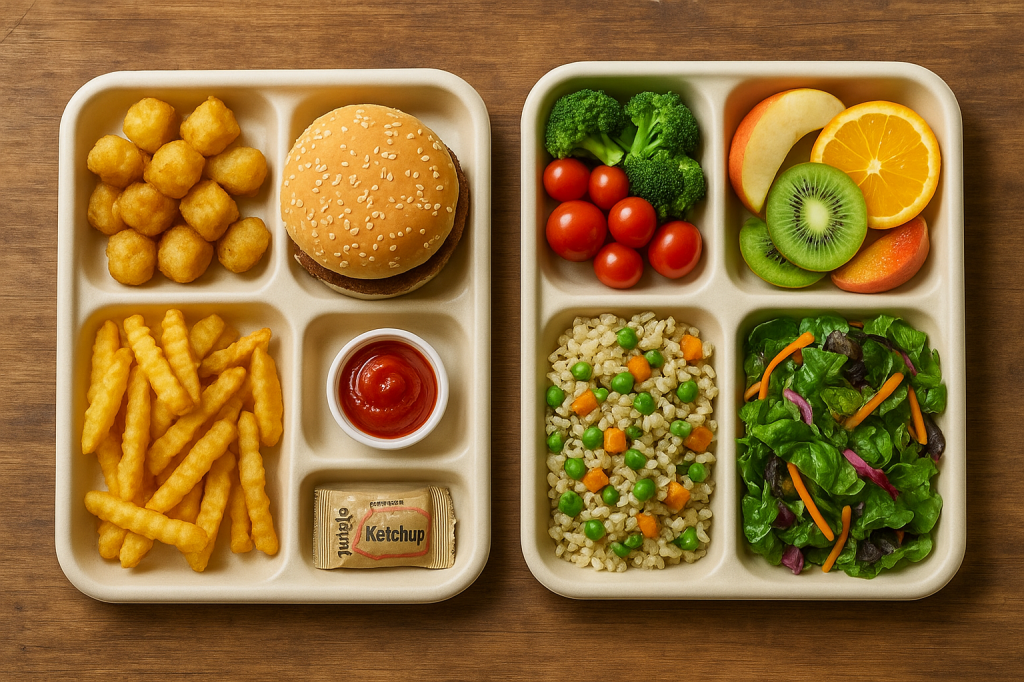
- School meals matter: Advocating for fresh, nourishing meals gives every child a better start to their day.
- Education matters: Teaching children (and families) about food empowers them to make healthier choices.
- Community matters: School gardens, local partnerships, and wellness initiatives bring healthy food closer to home.
Every step we take toward healthier, more accessible food is a step toward better focus, better behavior, and brighter futures.
A Call From My Heart
At Truly Wholistic Health and Wellness, we believe in whole-person healing. Our children deserve more than just survival, they deserve nourishment that allows them to thrive in body, mind, and spirit.
This isn’t only about changing what’s on the plate, it’s about changing what’s possible in their lives.
Together, let’s invest in real food, real wellness, and real change.
With love and purpose,
Chanel Williams
Founder, Truly Wholistic Health and Wellness
References
Bruening, M., Dinour, L. M., & Rosales Chavez, J. B. (2017). Food Insecurity and Emotional Health in the USA: A Systematic Narrative Review of Longitudinal Research. Public Health Nutrition, 1-9. https://doi.org/10.1017/S136898001700222
Dunn CG, Kenney E, Fleischhacker SE, Bleich SN. Feeding lowincome children during the COVID- 19 pandemic. N Engl J Med. 2020;382(18):e40. https://doi.org/10.1056/NEJMp2005638
(n.d.). DEPARTMENT OF HEALTH AND HUMAN SERVICES OFFICE OF THE ASSISTANT SECRETARY FOR HEALTH. Grants.gov. https://apply07.grants.gov/apply/ opportunities/instructions/PKG00267812-instructions.pdf
 Truly Wholistic Health and Wellness